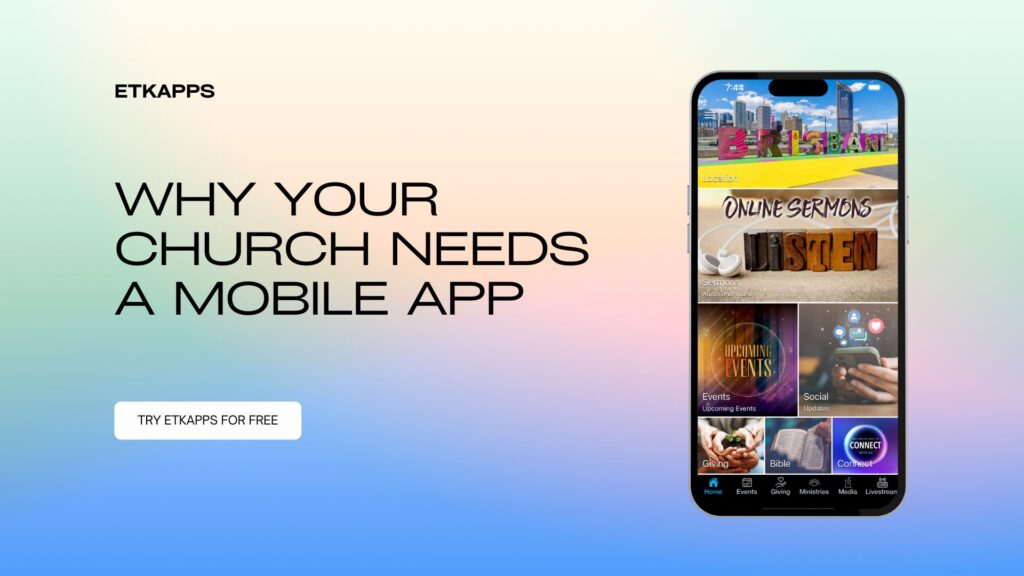
If you’ve started researching a mobile app for your church, you’ve probably hit two very different types of products, and the difference isn’t always explained clearly.
On one side: white-label or template apps. On the other: custom-branded apps built specifically for your church. Both can work. The right choice depends on what your church actually needs, what you’re willing to manage, and what you’re willing to spend.
This post explains the difference plainly, looks at the honest tradeoffs on both sides, and helps you figure out which model fits a 100–500 member church.
What “white-label” and “custom-branded” actually mean
White-label (template) apps are pre-built platforms where every church shares the same underlying app. Your church gets its own section inside the app (your name, maybe your logo), but the app itself is a shared product. Members download a generic app (like “Church App” or the platform’s own branded name) and then search for or log in to find your church’s content.
Some platforms in this category let you apply your church’s colours to your section of the app. That’s useful, but it’s still a shared container. Your congregation is using an app that’s also running services for thousands of other churches.
Custom-branded apps give your church its own dedicated app in the App Store and Google Play, listed under your church’s name, displaying your logo, using your colour scheme. Members search for your church by name and download your app. When they open it, there’s no platform branding, no “find your church” step, no other churches in view.
The experience for your congregation is meaningfully different. One is “the church app you’re part of.” The other is “our church’s app.”
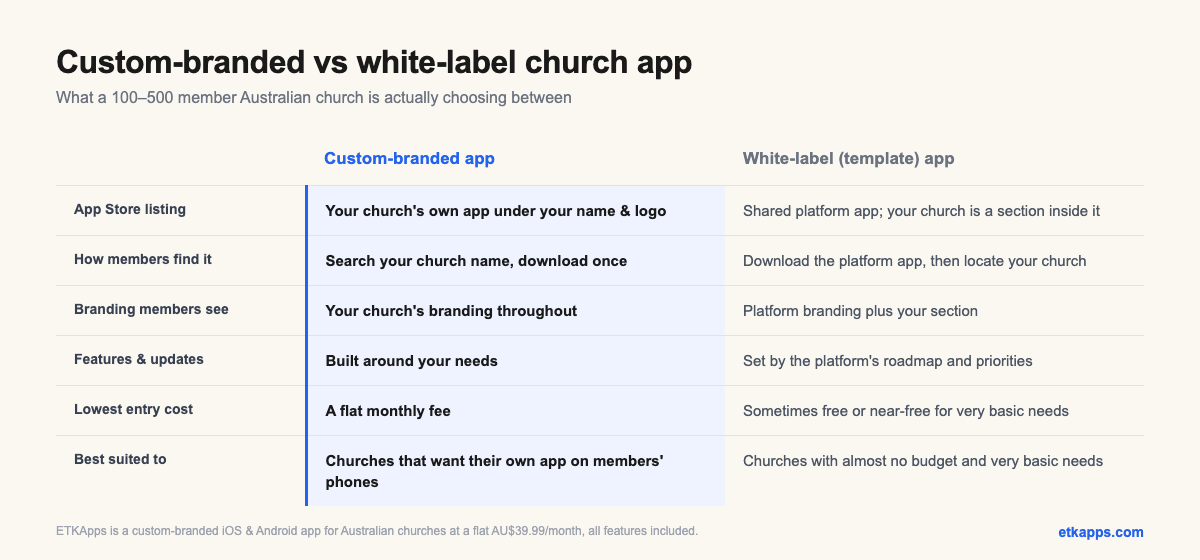
Custom-branded vs white-label at a glance
| Consideration | Custom-branded app | White-label (template) app |
|---|---|---|
| App Store listing | Listed under your church’s name and logo | Shared platform app; your church is a section inside it |
| How members find it | Search your church name, download once | Download the platform app, then locate your church |
| Branding members see | Your church’s branding throughout | Platform branding plus your section |
| Features and updates | Built around your needs | Set by the platform’s roadmap and priorities |
| Lowest entry cost | A flat monthly fee | Sometimes free or near-free for very basic needs |
| Best suited to | Churches that want their own app on members’ phones | Churches with almost no budget and very basic needs |
Where white-label wins
To give you an honest picture, there are genuine situations where a white-label or template platform is the right call.
Lower starting cost
Some white-label platforms have a free tier or a low-cost entry plan. If your church has almost no communications budget and just needs a basic sermon archive, a free or near-free platform may serve that need without any monthly commitment.
Faster setup for very basic needs
If you just want to post service times and a link to a YouTube stream, a template platform can get you there quickly without configuration decisions.
Established platforms with large communities
Some of the larger players (Subsplash, Tithe.ly) have been in the market for years and have extensive documentation and user communities. If your church is already in their ecosystem for giving, staying in one platform can reduce integration headaches.
These are real advantages. They’re worth weighing against the tradeoffs below.
Where the tradeoffs bite
White-label platforms tend to create friction in a few specific places that matter more than you’d expect for a small church.
The download step is a significant barrier
When you ask your congregation to “download our church app,” the flow matters. If they search the App Store for your church name and find your app listed under your name, the path is clear. If they need to download a platform app and then locate your church inside it, you’ve added a step that a meaningful percentage of people, particularly older members, will abandon. You’ve also branded the experience for the platform, not for your church.
Shared infrastructure means shared limitations
On a white-label platform, you’re subject to whatever features, design constraints, and update cycles the platform decides on. If the platform redesigns the app, your section changes. If they add features that benefit larger churches and not yours, you wait.
Pricing at scale isn’t always cheaper
The “low cost” appeal of some template platforms changes when you look at the full feature set. Tithe.ly’s All Access plan, which includes a custom church app alongside giving and church management tools, is priced at USD$119/month (approximately AU$182/month). Subsplash requires a quote for any paid plan; third-party review data puts real-world church spend at USD$249–$600/month for small-to-medium churches. Third-party review data puts Pushpay’s full bundle at USD$500–$1,500+/month, depending on church size. These platforms are not cheap. They’re just priced for a US market at US incomes.
A white-label free plan is genuinely cheaper than a custom-branded app. But a white-label plan with meaningful features often costs more. (For a fuller breakdown in Australian dollars, see our guide to church app costs in Australia.)
What a 100–500 member church actually needs
Let’s be specific about the size range this post is aimed at.
A church with 100–500 members is large enough to have real communication challenges: events that need more than a Facebook post, a congregation spread across multiple suburbs, members who’ve drifted from regular attendance and need re-engagement. But it’s small enough that you don’t have a dedicated IT team, a marketing budget with room to manoeuvre, or the volunteer hours to manage a complicated platform.
The features that actually move the needle for a church this size:
- Push notifications. The single highest-engagement channel for reaching a congregation that’s already opted in. A push notification lands on the lock screen. Facebook posts don’t. (More on this in push notifications vs Facebook.)
- Events calendar with RSVP. Not a link to a Google Calendar, but an in-app calendar your members can browse and confirm attendance from.
- Sermon archive. Audio or video, searchable, accessible between Sundays. This is often the most-used feature once members realise it exists.
- Online giving. Particularly for churches whose congregations are already comfortable with digital payments. Lower friction than pulling out cash or a cheque.
- Prayer requests and connection features. Simple, but they turn the app from a broadcast channel into a two-way pastoral tool.
What a 100–500 member church usually doesn’t need: advanced pastoral analytics tracking at-risk attendees (Pushpay recently acquired Nurture.io precisely for this kind of enterprise feature, and it’s not aimed at your size), multi-campus management, or a full church management system bundled with the app when you already have a spreadsheet or simple database that works.
The risk of over-buying is real. A platform with 40 features you’ll use three of is not better value than a platform with 12 features you’ll actually use.
Where ETKApps fits in this picture
ETKApps builds custom-branded iOS and Android apps (your church’s name in the App Store, your logo, your colours) at AU$39.99/month, all features included.
That price positions ETKApps in a specific place: it’s not a white-label template (your congregation gets a dedicated app, not a shared container), and it’s not a Subsplash-scale enterprise platform (no sales rep, no quote process, no 12-month contract). It’s a custom-branded app at a price point designed for Australian churches under the $50/month mark.
The feature set covers what the 100–500 member church actually uses: push notifications, events with RSVP, sermon archive, online giving via Stripe, livestream embedding, prayer requests, Bible integration, polls and forms, and an admin dashboard that a volunteer can manage without training. Nothing in the feature list exists to justify a higher price tier, because there’s only one tier.
The trade ETKApps makes is deliberate: fewer enterprise features (no church management system, no NFC giving, no pastoral analytics) in exchange for a simpler product at an accessible price, built and supported in Australia, in AEST hours, by people who understand the local church landscape.
Whether that trade suits your church depends on what you’re actually trying to solve. If you need a church management system or an existing giving platform integration, ETKApps may not be the right fit, and it’s worth saying that clearly rather than overselling. If you need your congregation to have your church’s app on their phones so you can reach them with a push notification before Sunday, ETKApps is designed for exactly that. (If you’re still weighing whether an app is worth it at all, start with why your church needs a mobile app.)
A simple way to decide
Before you compare platforms, write down the three things you most want your church app to do in the first 90 days. Then check whether each platform you’re evaluating actually does those three things at its entry price, not at a higher tier, not as a future roadmap item.
If push notifications, a sermon archive, and online giving are on your list, most platforms cover those. The differentiators are: who has to download what, what the monthly cost looks like in Australian dollars, and whether you’ll be talking to support staff in your timezone.
Key takeaways
- White-label apps share one container across many churches; custom-branded apps give your church its own listing under your name and logo.
- The download step matters. “Search and find us inside a platform app” loses people that “search our church name” doesn’t.
- Cheapest entry isn’t cheapest at scale. White-label free tiers are genuinely low-cost, but feature-complete plans can run well into hundreds of dollars a month.
- Buy for what you’ll use. A 100–500 member church rarely needs enterprise analytics, multi-campus tools, or a bundled church management system.
- Match the model to your goal. Need a custom app on members’ phones at a predictable AU price? That’s where ETKApps sits, at AU$39.99/month with all features included.
Frequently asked questions
What is the difference between a custom-branded and a white-label church app?
A custom-branded app is your church’s own app in the App Store and Google Play, listed under your name and logo, that members download directly. A white-label app is a shared platform where many churches use the same underlying app and your church appears as a section inside it.
Is a custom church app worth it for a small church?
For a 100–500 member church, the main benefit is a clear download path and your own branding on members’ phones, which matters most for reaching people through push notifications. If your needs are very basic and budget is near zero, a free white-label tier may be enough.
Are white-label church apps cheaper?
At the free or basic tier, yes. But feature-complete white-label plans aren’t always cheaper: published Tithe.ly All Access pricing is USD$119/month (about AU$182), and third-party data puts Subsplash at USD$249–$600/month and Pushpay at USD$500–$1,500+/month for small-to-medium churches.
What features does a small church app actually need?
Push notifications, an events calendar with RSVP, a searchable sermon archive, online giving, and prayer or connection features cover what most 100–500 member churches use. Enterprise analytics and church management systems usually aren’t necessary at this size.
How much does ETKApps cost?
ETKApps is AU$39.99/month with all features included, no contracts, and a 30-day free trial. It’s a custom-branded iOS and Android app built and supported in Australia.
See what your church’s app could look like
If you want to see what a custom-branded app looks like for your church, add your church free. ETKApps will set up a preview you can explore in the My Church app for 30 days, no credit card. Add your church at etkapps.com/add-your-church.
Sources: Subsplash pricing comes from third-party review data via SaaSworthy and Buildify (medium confidence; Subsplash does not publish list prices). Tithe.ly All Access pricing is published at tithe.ly/pricing (high confidence). Pushpay pricing comes from third-party review data via churchmemberpro.com (medium confidence). The Pushpay/Nurture.io acquisition is reported by Yahoo Finance and SoCoDigest (high confidence). The Pushpay/Barna 2026 State of Church Technology report comes via GlobeNewswire (high confidence, US survey data). All USD figures converted to AUD at approximate current rates for context only.