If you run communications for a church with 100 to 500 members, you have probably noticed something over the past few years: the channels you relied on are getting less reliable.
Your Facebook page posts to a fraction of your followers. Your email newsletter competes with inboxes that most people check twice a day. Your Sunday bulletin gets left on the seat. And your congregation members, despite being genuinely committed to the community, miss events they would have attended if they had known about them.
A mobile app will not fix every communication problem. But it does solve a specific, practical one: getting information directly into the hands of the people who want it, without depending on an algorithm deciding whether they see it.
This article looks at why a church mobile app makes sense for small to medium Australian churches, what to actually use it for, and what it realistically costs.

Why Facebook is no longer a reliable church communication channel
Most Australian churches built their digital communications around Facebook. It made sense at the time: it was free, most people had an account, and it was easy to post an event or announcement.
The problem is that organic reach for Facebook Pages has declined sharply. According to Caffeinated Church, which tracks church communications data, average organic reach for a Facebook Page is now 2–5% of followers, with many business and organisation pages seeing 1–2%. Facebook Groups perform better (20–40% organic reach), but they require members to actively opt in and check them.
That means if your church page has 400 followers, a typical post might be seen by 8 to 20 people before you pay to boost it. For an event reminder posted on Thursday, that number is not going to fill the seats.
This is not a temporary glitch in the algorithm. It reflects Facebook’s deliberate business model: Pages reach people less; paid promotion reaches people more. Australian churches have largely absorbed this shift quietly, but the practical result is that a channel many congregations still treat as their primary communication tool is reaching a small minority of their community.
A mobile app with push notifications works differently. When you send a push notification, it arrives on the device. Members do not need to be scrolling Facebook at the right moment. The notification badge sits there until they open it.
What a church mobile app actually gets used for
The usefulness of a church mobile app comes down to a handful of features that churches use every week.
Push notifications are the most immediate benefit. Event reminders, service time changes, last-minute announcements, and prayer requests all go directly to your congregation’s phones. This is not the same as posting on Facebook or sending an email: a push notification has a different psychological weight. It feels like a direct message, because it essentially is.
An events calendar gives your congregation a single place to check what is happening. No more “I didn’t know about that” conversations after the fact. Members can see the full schedule and RSVP so you have a reliable headcount.
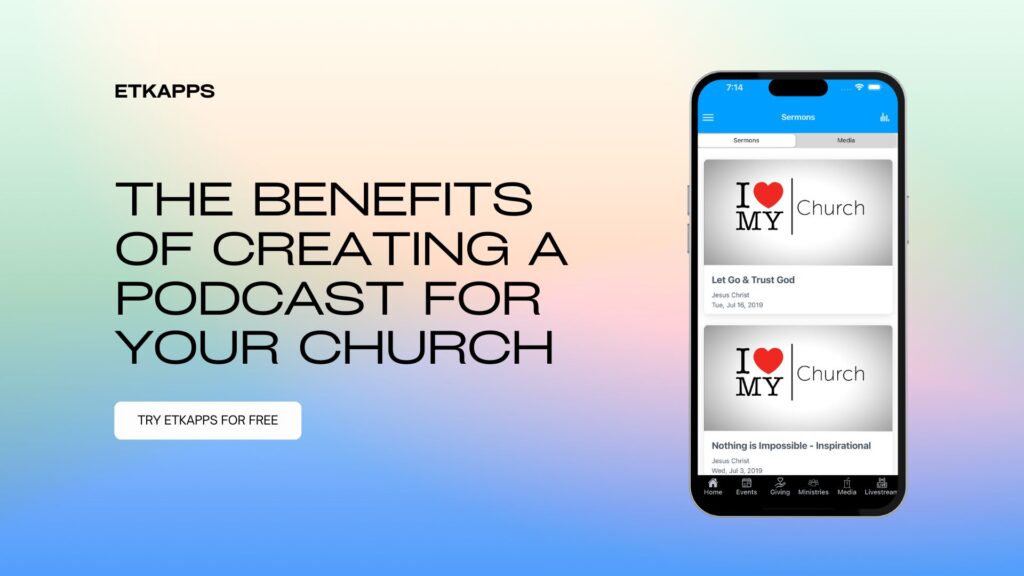
Sermon archive means a member who missed a Sunday, or who wants to revisit a message from three months ago, can do that without having to find a YouTube link or hunt through a Facebook feed. Audio and video both work.
Online giving via a properly integrated payment system (Stripe, in ETKApps’ case) removes friction from a moment where friction is particularly costly. A member who wants to give but does not carry cash, and does not have a direct debit set up, now has a two-tap option in an app that is already on their phone.
Prayer requests give your congregation a way to submit needs without having to track down a pastor or wait until Sunday. Ministry teams can see and respond to requests without email chains.
None of these features require your church to become a technology organisation. They require someone to log into a dashboard once or twice a week and do the same administrative work they were already doing, just in a more useful channel.
The real question: does a church your size need one?
The honest answer for most churches with 100–500 members: probably yes, if you are currently over-reliant on Facebook or email to reach your congregation.
Here is a practical way to think about it. In 2026, 59% of church leaders surveyed by Pushpay and Barna Group said they plan to adopt a mobile church app within three years. That survey was US-based, and Australian churches tend to follow US technology trends rather than lead them, so the same shift is likely heading here. Either way, churches that move now are ahead of the curve rather than scrambling to catch up later.
The question is not really whether to adopt one. The question is whether your church can afford to wait, and whether the tool you choose will suit a church of your size and budget.
What it costs, and what the alternatives cost
The pricing landscape for church apps breaks sharply between the large US platforms and the options built for smaller Australian churches.
Subsplash, which was acquired by Roper Technologies for $800 million in 2025 and serves 20,000+ faith-based organisations globally, does not publish pricing. Third-party review data places real-world spend for small to medium churches at approximately AU$375–AU$915 per month, based on the estimated USD $249–$600/month range (as at 2026). Multi-year contracts are commonly reported.
Pushpay, which is available in Australia and now offers pastoral engagement analytics through its acquisition of Nurture.io, is similarly structured for larger churches. Third-party review data (churchmemberpro.com, 2026) places full-bundle pricing at roughly AU$770–AU$2,310+ per month, and Pushpay does not publish official prices.
Tithe.ly’s All Access plan, which bundles an app with a church management system and website builder, is published at $119 USD per month (approximately AU$182 at current rates). That is more transparent pricing, but the bundle includes tools many small churches do not need and would prefer not to manage.
ETKApps is AU$39.99 per month, all features included, no lock-in contract. That is under $10 per week, which for a 100-person congregation is less than a printed bulletin per member per week.
The price difference is not primarily about features. It is about who the product is designed for. The large US platforms are built around the needs of churches with dedicated operations staff and significant technology budgets. ETKApps is built for an Australian church where the pastor or a volunteer administrator manages communications alongside everything else.
How the trial works (and what to expect)
Getting started does not require a technical project. The process is:
1. Fill in the Add Your Church form (free, no credit card required).
2. ETKApps configures your church in the dashboard, with your branding, events, and content structure.
3. You receive a link to download the free My Church app, where you search for your church and preview your configured app for 30 days.
4. If you decide to subscribe, ETKApps builds your custom-branded iOS and Android app from that configured church.
The 30-day preview lets you see exactly what your congregation would see before you commit to anything. You can test push notifications, add a few events, and share the preview link with your leadership team. There is no sales call required to see the product.
Frequently asked questions
Will my congregation actually download and use an app?
Adoption depends on how you introduce it. Churches that see the best uptake typically announce the app from the pulpit, send a direct email with the download link, and use the app for communications that previously went through Facebook or email. When the app becomes the primary channel for notifications and events, rather than a supplement to existing channels, download rates follow.
Do I need to be technical to manage the app?
No. The ETKApps dashboard is designed for church administrators, not developers. Adding an event, sending a push notification, and uploading a sermon recording are all straightforward tasks. If you can post to a Facebook page, you can manage the app dashboard.
What happens if we decide it is not right for us?
The trial is free and requires no credit card. If you subscribe and later want to stop, there is no lock-in contract. Month-to-month billing means you can cancel at any time. There are no early termination fees.
The bottom line
A church mobile app is not a novelty for larger churches. For a small to medium Australian church dealing with declining Facebook reach and congregation members who are missing events and updates, it is a practical communication tool with a clear weekly use case.
The right app costs less than most church administrators expect, and it does not require technical expertise to run. The harder question is usually not whether it makes sense, but when to start.
If you are ready to see what it looks like for your specific church, you can add your church free and preview your app for 30 days with no credit card required.