You post the Sunday service time change on Facebook. You boost the Easter event. You remind the congregation about the working bee on Saturday. And then you wonder why half the people who show up didn’t seem to know about any of it.
Here’s the uncomfortable truth: most of your congregation never saw those posts.
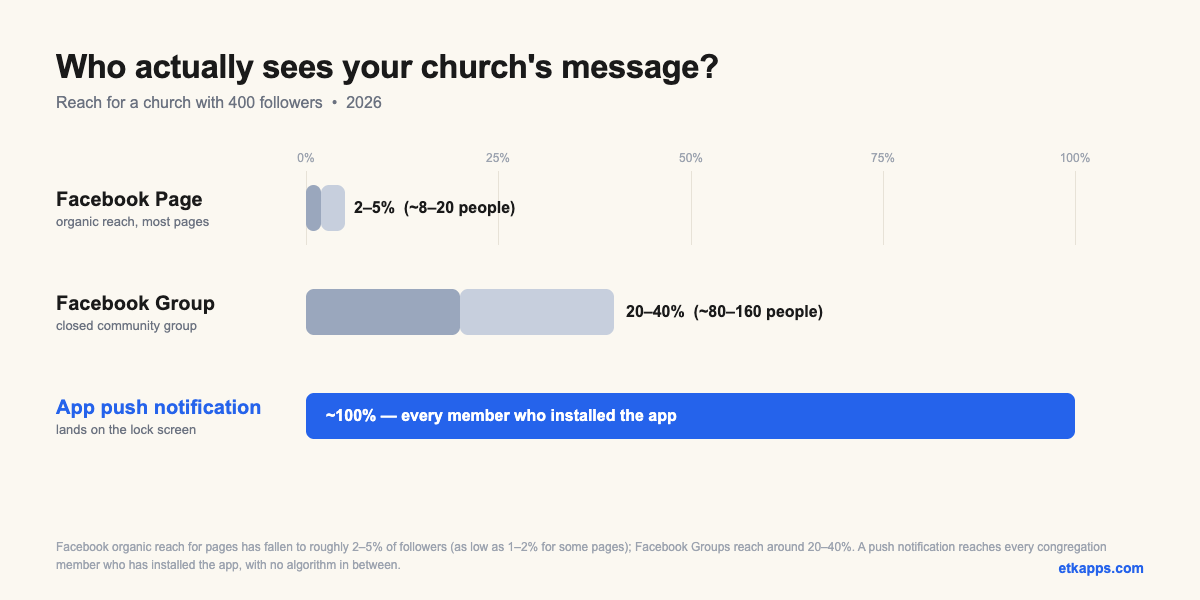
Facebook organic reach for pages has fallen to 2–5% of followers for most organisations, and for standard business and community pages it can drop as low as 1–2%. If your church page has 400 followers, somewhere between 4 and 20 people are actually seeing each post you put up.
That is not a communication strategy. That is shouting into a very loud room and hoping someone nearby hears you.
This post is about what actually works instead, and why church push notifications through a mobile app have become the most reliable way for small Australian churches to reach their whole congregation.
Key takeaways
- Facebook organic reach for pages now sits at roughly 2–5% of followers, so most of your congregation never sees your posts.
- A push notification lands directly on the lock screen of every member who has installed the app, with no algorithm in the way.
- Push is best for time-sensitive and pastoral messages; Facebook is still useful for discovery and community conversation.
- Custom-branded church apps used to be priced for large US churches; ETKApps is built for Australian churches in the 100–500 member range at AU$39.99/month.
Why Facebook Has Changed, and Why It Is Not Going Back
Facebook’s algorithm prioritises content from friends and family, paid advertising, and Facebook Groups. Pages (which is almost certainly how your church has a Facebook presence) are treated as publishers, not community members. Organic reach for pages has been declining consistently for years and the platform has given no indication that will reverse.
Facebook Groups do perform better, with organic reach sitting around 20–40%. Some churches have responded by migrating their community into a closed Group rather than a public Page, and that can help. But it still leaves you dependent on a third-party platform, vulnerable to algorithm shifts, and competing with baby photos and political arguments for your congregation’s attention.
The other limitation is that Facebook skews older. Gen Z and Millennials are less likely to check it regularly. If you want to reach younger families in your congregation, the ones you most want to keep engaged, Facebook is increasingly not where they are.
What Push Notifications Actually Do Differently
A push notification lands on someone’s phone lock screen. They do not need to be scrolling at the right moment. They do not need to have the app open. They do not need the algorithm to decide they should see it.
When you send a push notification from a church app, it goes to every member who has installed the app and has notifications enabled. Not 2–5%. All of them.
That changes how you communicate. An event reminder sent the morning of has a genuine chance of being seen. A weather cancellation notice gets through in time to matter. A pastoral announcement during the week reaches people while they still have time to respond.
It also changes how congregation members feel. There is a practical difference between finding out about something through the church grapevine three days later and getting a direct notification from your church’s app. One feels like belonging; the other feels like you almost missed it.
A 2026 Pushpay/Barna survey of over 1,300 church leaders found that 79% say technology helps congregations feel more connected, and 59% plan to adopt a mobile church app within three years. That is not a fringe view. It is where Australian churches are heading, and for most, the US churches in that survey are about 12–24 months ahead.
What This Looks Like in Practice
Consider a typical week for a small to mid-sized church running communications through Facebook and email:
- You post the service time on Monday. By Sunday, most people have forgotten what they saw, if they saw it at all.
- You send an email newsletter. It reaches more people than Facebook does, but plenty of inboxes never open it, and you have no way of knowing which.
- Your Sunday bulletin is the most reliable channel. But it only reaches people who were already there last week.
Now consider the same week with a church app and push notifications:
- Sunday afternoon: a push notification summarising what’s on next week. Arrives when people are still thinking about church.
- Thursday morning: a reminder for Friday’s small group or Saturday’s working bee. Arrives two days before, when there is still time to plan.
- Saturday afternoon: a weather update or a last-minute change. Goes out immediately, reaches everyone.
The app also gives congregation members something to check when they want to: the events calendar, the sermon recording from last week, the giving button when they missed the collection. You are not limited to push in one direction; you are building a space your congregation actually uses.
If you have not read our post on why your church needs a mobile app, it covers the broader case for having an app in the first place. And if you are thinking specifically about keeping congregation members engaged between Sundays, improving church engagement with an app goes deeper on the day-to-day mechanics.
The Honest Case for Church Apps in Australia
Church app adoption in Australia is still early. That is actually an advantage for churches that move now. You are setting the habit with your congregation before it feels like just another notification they dismiss.
The practical question for most small Australian churches is cost. A custom-branded app has historically been something only larger churches could afford, because the US platforms priced accordingly. Subsplash, for instance, runs at an estimated AU$375–AU$915/month for a small to medium church. Pushpay sits at an estimated AU$300–AU$760+/month for comparable feature sets. Those are prices designed for large US congregations with dedicated communications staff. We break the numbers down further in our guide to what a church app should cost in Australia.
ETKApps was built for Australian churches in the 100–500 member range that cannot or should not spend that kind of money on a communications tool. It is a custom-branded iOS and Android app (your name, your logo, your colours) with push notifications, an events calendar, sermon archive, online giving via Stripe, and the other features your congregation actually uses. One subscription, AU$39.99 per month, no lock-in, 30-day free trial with no credit card required. If you are weighing a built-for-you app against a generic template, our comparison of custom versus white-label church apps is worth a read.
That is less than a single printed bulletin per week for a 100-person congregation.
The app is built and supported in Australia, which matters for things that do not show up in feature lists: someone answering support questions during AEST hours, understanding the difference between a Baptist and an Anglican church’s communication style, knowing what “working bee” means without an explanation.
Is Facebook Still Worth Keeping?
Yes, with clear expectations about what it does and does not do.
Facebook Groups remain useful for community conversation. A closed Group for your congregation can foster discussion in a way a push notification cannot. Your Page is still worth maintaining for public visibility and for reaching people who are not yet congregation members.
But Facebook should not be your primary channel for time-sensitive or pastoral communications. When it matters that people actually see something, whether a service time change, a pastoral announcement, or a care need in the community, you need a channel where you know the message will land.
Push notifications are that channel.
The shift in thinking is straightforward: use Facebook for discovery and community conversation, and use your church app for direct communication with your congregation. They are different tools for different purposes, and trying to make Facebook do both is what leads to that frustrating situation where you posted something three times and people still did not know about it.
Getting Started
If you are currently running church communications through Facebook, a website, and emails, moving to a church app does not mean abandoning what is working. It means adding a direct channel to the mix, one that reliably gets through.
ETKApps sets up in under an hour of admin time. There is no IT project. The admin dashboard is designed to be run by a volunteer who logs in once a week to send a notification and update the events calendar, not by someone who manages software for a living.
The 30-day free trial lets you preview your own app, with your branding and your content, before you commit. No credit card, no obligation. Just add your church free at etkapps.com/add-your-church.
If you have questions or want to talk through whether it is a fit for your church, you are welcome to get in touch with the team at [email protected].
Frequently asked questions
How many of my Facebook followers actually see each post?
For most pages, organic reach has fallen to roughly 2–5% of followers, and standard business and community pages can drop as low as 1–2%. A church page with 400 followers is typically reaching only 4 to 20 people per post.
Do push notifications reach everyone in my congregation?
A push notification goes to every member who has installed the app and has notifications enabled, not a small algorithm-selected slice. It lands directly on the phone’s lock screen, so people see it without needing to open the app or scroll at the right moment.
Should we stop using Facebook altogether?
No. Facebook Groups are still useful for community conversation, and your Page helps with public visibility and reaching people who are not yet members. Use Facebook for discovery and conversation, and use your church app for direct, time-sensitive communication.
How much does a church app cost in Australia?
US platforms like Subsplash and Pushpay are estimated at roughly AU$300 to AU$915+ per month, priced for large congregations. ETKApps is AU$39.99 per month with all features, no contracts, and a 30-day free trial, built for Australian churches in the 100–500 member range.
How much work is it to run?
Setup takes under an hour of admin time with no IT project involved. The dashboard is designed for a volunteer to log in roughly once a week to send a notification and update the events calendar.
Sources: Facebook organic reach 2–5% for pages and 20–40% for Groups, from Caffeinated Church (2026). 79% of church leaders say technology helps congregations feel connected and 59% plan to adopt a church app within three years, per the Pushpay/Barna 2026 State of Church Technology Report, via GlobeNewswire (2026). Subsplash estimated pricing AU$375–AU$915/month and Pushpay estimated pricing AU$300–AU$760+/month, from Church Member Pro and Investing.com AU (2026).